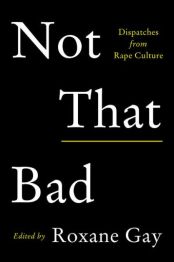
 Roxane Gay began this anthology in an attempt to unravel the nebulous concept of “rape culture”– to engage with the question, “What is it like to live in a culture where it often seems like it is a question of when, not if, a woman will encounter some kind of sexual violence?” Ultimately, this piece became a place where diverse individuals across the gender spectrum could reclaim their own stories, free from expectations about what it means to carry the burden of trauma.
Gay and the contributing authors created a space where it’s okay to say, “It WAS that bad. It still is.” This anthology does not offer simple truths about sexual violence or a literary tonic for those scarred by it, but it does provide insight into why these kinds of stories are silenced and why every one of them matters. The authors, so far beyond vulnerable, offer readers the broken bits of themselves so that their experiences might become something more than a car crash everyone likes to observe in a most unhelpful way.
“I’m writing this so it can be a part of the compendium of other sad and bad stories like these, because maybe the compendium will say something in totality that we cannot say alone.”
These stories are brimming with emotional chaos and contradictions, but together, the voices ring true in a kind of perverse harmony of pain and healing. Together, the survivors scream unapologetically that each of us matter, and this can’t continue. Every time someone musters the courage to speak up, every time we refuse to diminish our own pain for the sake of others, the Movement is that much closer to holding people accountable for the suffering they’ve inflicted and a little bit closer to a cultural revolution.

“It’s time to pull out the scalpel and turn it around. Slash vents in the paper walls of this master’s house of heteropatriarchal colonialist mass hallucination that claims to be our reality. Give vent to our rage. Be bad. Dare to survive.” –So Mayer
 In the Affairs of the Falcóns, Rivero illustrates the complex politics and emotions at play within a single family trying to make their way as immigrants in a the US: the racism and classism within the Peruvian community, strained loyalties and the dissolution of marriages, children being raised as Americans but frequently reminded that they are outsiders, the economic and political regimes that cause widespread displacement, and the sacrifices people will justify in the name of love and survival.
 From an outsider’s view, Wang’s identity stands apart from the common conception of someone with schizoaffective disorder—she is ivy-league educated, exceedingly well-dressed, and “high-functioning” when she is not in the grips of psychosis. After being kicked out of her university for her mental health status, Wang begins a never ending journey into a health system whose diagnoses, treatments, and policies are often at odds with her autonomy and humanity.
 From the beloved queer Chicana feminist writer Cherríe Moraga, Native Country of the Heart is a memoir told in parallel with the memoir of her Mexican mother, Elvira. Elvira is the foundational stone on which Moraga builds her own Chicana feminism and family, a woman whose beauty, rage, and fuerza incansable were unmatched in the eyes of Cherríe. Cherríe Moraga’s life story is one of reclamation and resistance: reclaiming her indigenous Californian and Mexican roots in a Gringo world, while resisting the shame and guilt forged by the patriarchy and religion of her family’s culture.
 Reading Mouthful of Birds feels like occupying some kind of hybrid world of dreams and folklore, where the subconscious masquerades as a stream of characters enacting scenes that aren’t fully coherent with reality, but every moment is vivid and visceral. The short stories are full of nightmarish scenarios, like someone auditioning to be an assassin by proving their capacity for violence, a man being held captive at a train station indefinitely because he didn’t have the correct change for a ticket, or a teenage girl who will suddenly only eat live birds. The protagonists are oblivious to the bewildering circumstances they are about to endure, and like many of us in our truest nightmares, the characters find themselves misunderstood or full of regret.
 ode to shelf-care